
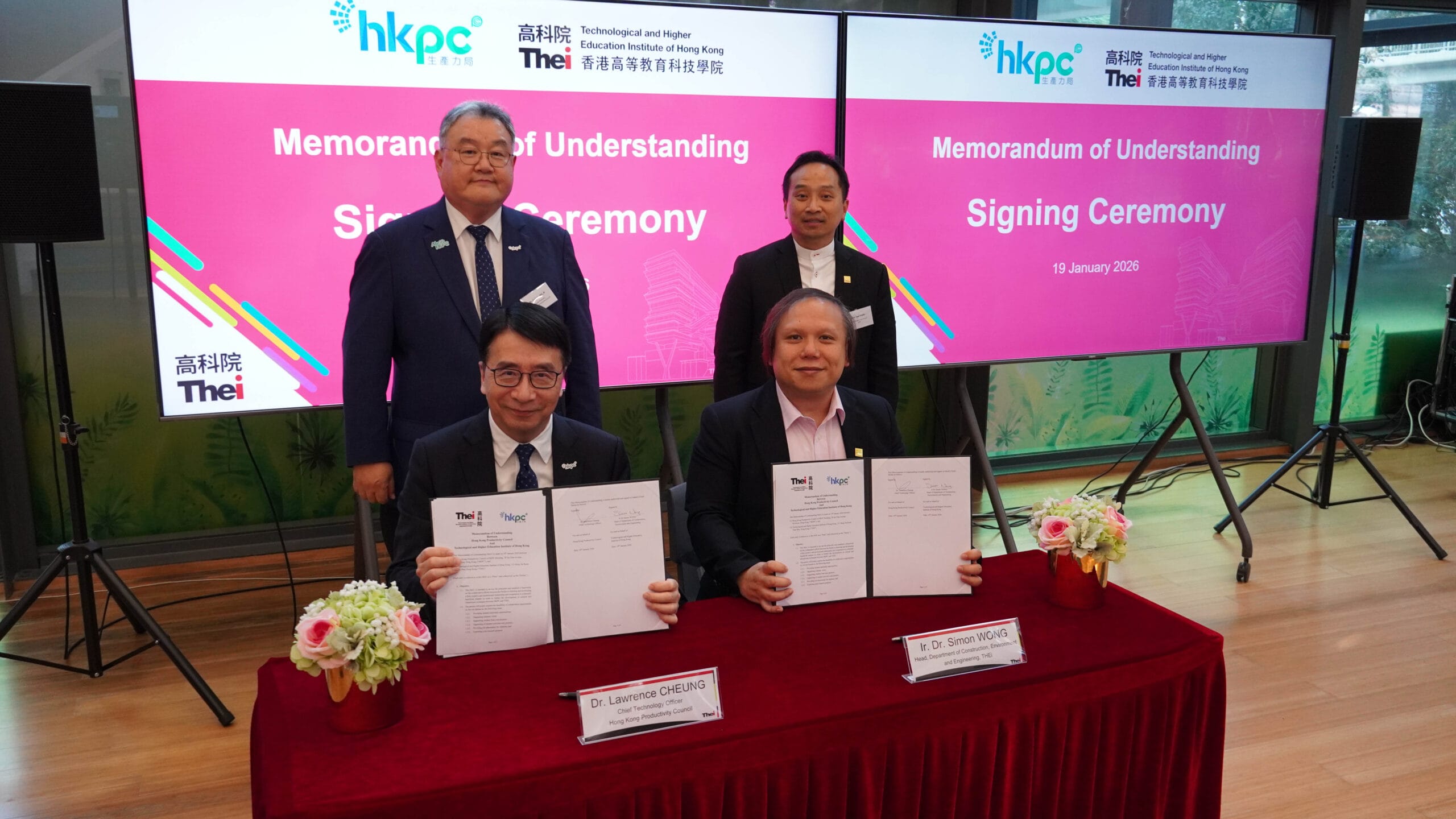
(Hong Kong, 30 January 2026) The Technological and Higher Education Institute of Hong Kong (THEi) and the Hong Kong Productivity Council (HKPC) signed a Memorandum of Understanding (MoU), marking a significant step for both parties in fostering the integration of applied sciences and industry. The partnership aims to provide students with diverse academic research and practical opportunities to cultivate applied talent equipped with innovative thinking and practical skills, thereby supporting the industrial growth in Hong Kong and the Greater Bay Area.
The signing ceremony of the MoU took place on Monday (19 January) at THEi Chai Wan Campus. Witnessed by Professor Paul TSANG Wai-kei, Vice President (Academic) of THEi and Mr Emil YU Chen-on, BBS, JP, Deputy Chairman of HKPC, the MoU was signed by Ir Dr Simon WONG Ho-fai, Head of the Department of Construction, Environment and Engineering at THEi and Dr Lawrence CHEUNG Chi-chong, Chief Technology Officer of HKPC.
Professor Paul TSANG Wai-kei, Vice President (Academic) of THEi, emphasised that both THEi and HKPC attach great importance to translating academic research and technological development into practical applications. He hopes this collaboration will offer students in various programmes – including Bachelor of Engineering (Honours) in Digital Manufacturing, Bachelor of Science (Honours) in Cyber Security, and Bachelor of Engineering (Honours) in Electric Vehicle Design and Technology* programmes – more training and hands-on experiences, equipping them with the competencies needed to support industry advancement and the development of industries after graduation.
Mr Emil YU Chen-on, BBS, JP, Deputy Chairman of HKPC, stated that HKPC will provide THEi students with comprehensive and diversified internship and learning opportunities. A variety of student activities and applied learning projects will be organised to support students in applying their knowledge in a real working environment and gaining valuable hands‑on experience. HKPC will also work closely with THEi to explore potential joint research projects, with the aim of nurturing future talent, strengthening the innovation and technology (I&T) ecosystem, and jointly advancing the sustainable development of Hong Kong’s I&T sector.
After the signing ceremony, representatives from the HKPC visited the cutting-edge teaching facilities at THEi, including Hydrogen Energy Education and Talent Development Centre (Funded by the Environment and Conservation Fund), Sports Biomechanics Laboratory, Human Performance Laboratory, and Functional Training & Injury Prevention Centre.
According to the MoU, THEi and HKPC will foster exchanges and strengthen collaboration in the field of applied sciences. This includes launching joint research projects, providing internship opportunities, organising industry visits, and facilitating employment matching, all aimed at cultivating applied talents for Hong Kong and the Greater Bay Area.
*The programme is newly offered in AY2026/27. The programme will undergo learning programme accreditation with the Hong Kong Council for Accreditation of Academic and Vocational Qualifications in 2026.
Photo Caption:
- Picture 1: THEi and HKPC signs a MoU. Witnessed by Professor Paul TSANG Wai-kei, Vice President (Academic) of THEi (back row, right) and Mr Emil YU Chen-on, BBS, JP, Deputy Chairman of HKPC (back row, left), the MoU is signed by Ir Dr Simon WONG Ho-fai, Head of the Department of Construction, Environment and Engineering at THEi (front row, right) and Dr Lawrence CHEUNG Chi-chong, Chief Technology Officer of HKPC (front row, left).
- Picture 2: Representatives from the HKPC visited the cutting-edge teaching facilities at THEi. The picture shows Hydrogen Energy Education and Talent Development Centre (Funded by the Environment and Conservation Fund).
- Picture 3: Representatives from the HKPC visited the cutting-edge teaching facilities at THEi. The picture shows Functional Training & Injury Prevention Centre.
- Picture 4: Professor Paul TSANG Wai-kei, Vice President (Academic) of THEi, delivers a speech during the signing ceremony.
- Picture 5: Mr Emil YU Chen-on, BBS, JP, Deputy Chairman of HKPC, delivers a speech during the signing ceremony.