
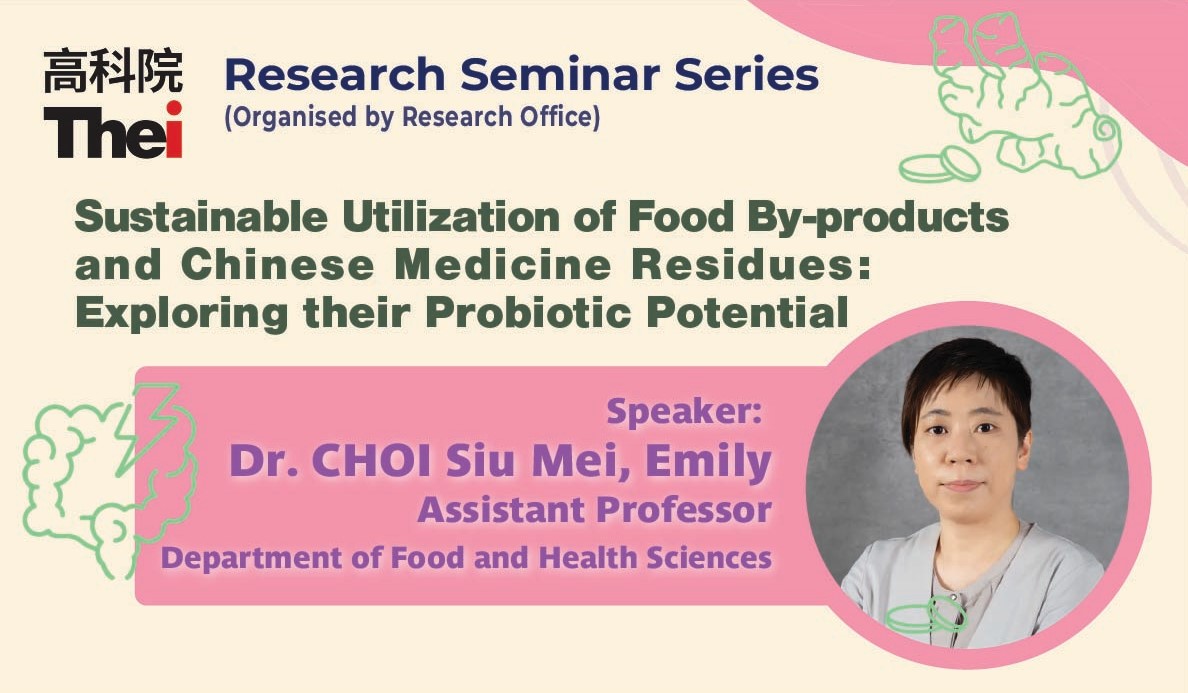
This research explored the potential of spent coffee grounds (food by-products) and Smilax glabra Roxb. (Tufuling) residue (Chinese medicine residues) as prebiotics to stimulate the growth of probiotics in the gastrointestinal tract for health promoting effects. The gut microbiota can degrade prebiotics for metabolism to support the probiotic bacterial growth. The study aimed to reduce the waste through the upcycling of food by-products and Chinese medicinal herbal residues as well as sustainable exploitation of natural resources of prebiotics.
The coffee beverage industry is one of the popular ready-to-eat food products industry and produces a significant amount of food by-products after processing. Spent coffee grounds are rich in non-indigestible carbohydrate and could be explored as a potential source of prebiotics to support probiotic growth. Based on our previous study, selected probiotic bacteria (Lactiplantibacillus plantarum subsp. plantarum ATCC14917, Lactobacillus delbrueckii subsp. bulgaricus ATCC11842 and Bifidobacterium longum subsp. longum ATCC15707) which demonstrated ability to reduce acrylamide (Choi et al., 2023) will be used to evaluate the potential prebiotic effect of extracted polysaccharides from spent coffee grounds.
Tufuling is the dried rhizome of Smilax glabra Roxb. under Liliaceae family. It is a traditional Chinese medicine grown in Southern China. It could unblock and promote the joints, remove dampness, and eliminate toxicity. Tufuling demonstrated cardiovascular protective, hepatoprotective effect, anti- bacterial, anti-hyperglycemic and anti-inflammatory effects (Du et al., 2000; Fukunaga et al., 1997; Xu, 1993; Wang et al., 2006). It has been used as a traditional Chinese medicinal material for herbal beverages industry. Tufuling was found to have blood glucose lowing effect. It could reduce blood glucose level in both non-insulin-dependent diabetic mice and normal mice (Fukunaga et al., 1997). Tufuling was also found to have protective effect on ulcer by preventing free radical damage, up-regulating the pH of gastric juice, inducing gastric juice secretion, and suppressing lipid peroxidation in the stomach mucosa (Du et al., 2000).
The spent coffee grounds and tufuling residues are considered to have potential health benefits due to the presence of dietary fibre which may function as prebiotics to stimulate the growth of probiotics. This study mainly focused on (1) the extraction and purification of polysaccharides from the spent coffee grounds and tufuling residues; (2) the analysis of chemical and functional characteristics of the extracted polysaccharides and (3) the evaluation of the prebiotic effects of extracted polysaccharides on Lactiplantibacillus plantarum subsp. plantarum ATCC14917, Lactobacillus delbrueckii subsp. bulgaricus ATCC11842 and Bifidobacterium longum subsp. longum ATCC15707. The total numbers of viable cells (CFU/mL) with or without extracted polysaccharides after incubation will be compared. These extracted polysaccharides could be applied as novel sources of prebiotics if an increase in the population of tested probiotics will be resulted.
This research project proposed that the spent coffee grounds and tufuling residues could be further utilized as functional food ingredients with prebiotic effects in promoting the growth of probiotics and the relevant health benefits in human. The production of various prebiotics from these waste materials can provide a value-added novel conversion of waste to prebiotics for human health.
Acknowledgement
This work was supported by a grant from the Research Grants Council of the Hong Kong Special Administrative Region, China (UGC/FDS25/M03/24).